Sold on this site
Half day with glass bottom
Short and early or late
- Island time1.5 hours
- Crossing30 minutes
- Group23 guests at most
Guides
Language
Currency
Check datesstarting at $173 · free cancellationClickable checklist
Low Isles glass bottom boat and snorkel from Port Douglas
★ 4.7 · 521 written reviews
Answer in brief
Low Isles snorkeling is shallow and calm, 0 to 5 metres deep and entered from the beach or the boat, which makes it a good first reef, with the clearest water from May to October.
Before you swim
Checklist: 11 items
Work through the list and tick items. Progress is saved on this device.
0 / 11 ready
Everything is ready. Only the date and your departure time are left to choose.
Claim a spotLow Isles snorkeling is shallow, calm and close to the sand, which makes it a gentle first reef. Here is how deep it gets, where you get in, what you will likely see and what to wear.
Editorial team, lowislestour.com · Updated November 8, 2026 · A 9 min read
Main facts
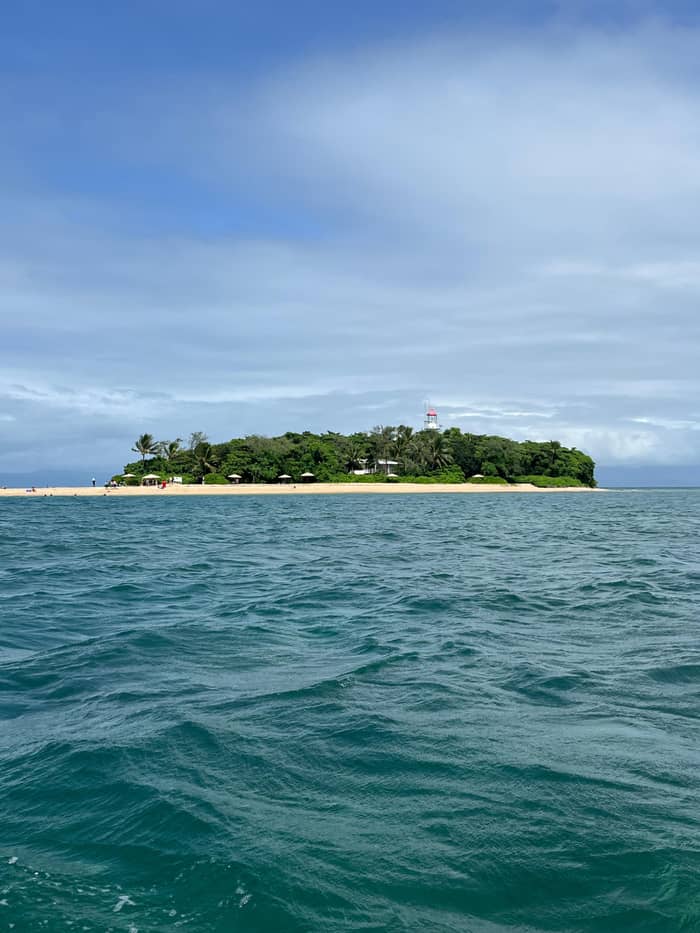
Low Isles snorkeling happens in a sheltered lagoon rather than on a wall of open reef. Quicksilver, which has sailed here for decades, gives the snorkeling depth as 0 to 5 metres and notes that the corals sit close to the island.1 Calypso, whose vessel runs the trip sold on this site, says you can reach the reef either off the back of its boat or straight from the beach, because the reef hugs the shore.2 You float above sand, rubble and coral heads, with the white beach a few strokes behind you.
The reef is richer than its size suggests. Tourism Port Douglas Daintree counts 150 species of hard coral around Low Isles, although the reef is dominated by 15 species of soft coral.8 Parrotfish in blue, green and purple are a common sight, along with angelfish, damselfish, clownfish, trevally, sweetlip and moon wrasse.9 Quicksilver adds rabbitfish and surgeonfish to the grazers you meet over patches of algae.10 Slow down and the small life appears: sea cucumbers on the sand, butterflyfish moving between coral heads, a turtle lifting its head for air.
So, is Low Isles good for snorkeling? For a first reef day, yes, and for confident swimmers it is pleasant rather than spectacular. Quicksilver is frank about it: an inshore reef like this one gets more nutrients and fine silt, and murkier water, than the reefs offshore.11 For water clarity, Tourism Australia points reef-goers from Port Douglas to the months of May to October.7 Some reviewers of the trip sold here found the water murky on their day, while others swam with turtles, so treat clarity as weather-dependent and the turtles as the likelier reward.
Snorkeling by trip
| Trip | Getting in | Guide | Suits and gear |
|---|---|---|---|
| Half day, glass bottom boat | Back of the boat or the beach2 | Crew-led, with a glass bottom boat ride | Snorkel gear and lycra suits included21 |
| Wavedancer full day | From the island only16 | Marine biologist talk and beach walk | Child sizes, free vests22,23 |
| Sailaway full day | In the lagoon, boat moored | Marine naturalist snorkel tour | Prescription masks on board24 |
| Sailaway afternoon | In the lagoon, boat moored | Marine naturalist snorkel tour | Seasonal lycra or wetsuits, flotation |
Compiled from each operator's website and the booking listings; ask the crew on the day, as gear and routines can change with the season.21,16
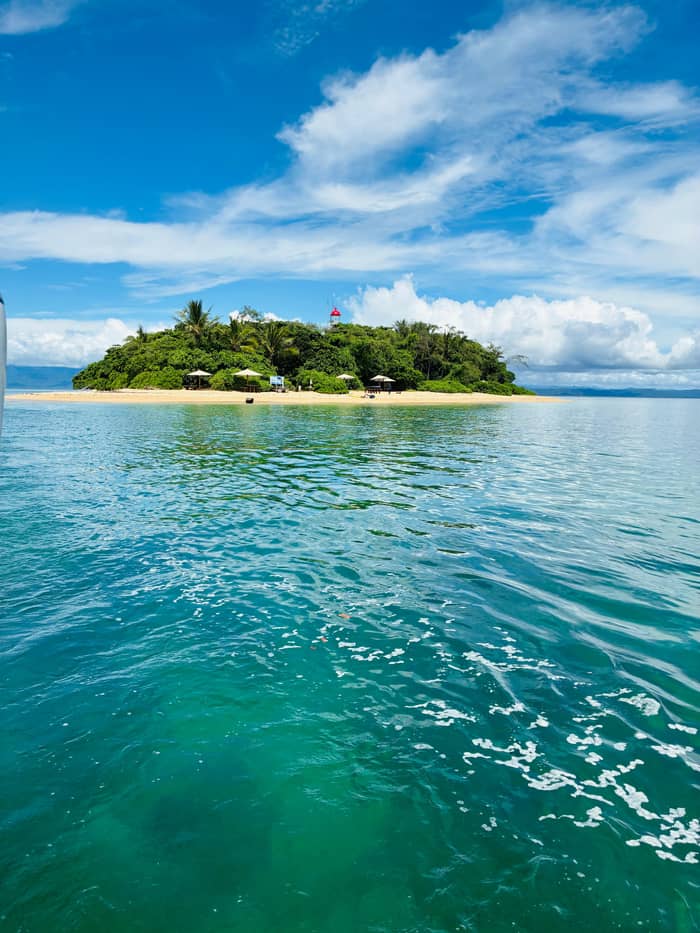
How you get into the water depends on the operator. On the Wavedancer sailing catamaran every snorkel, the guided tour included, starts from the island itself, and permanent umbrellas stand on the sand.16 Quicksilver runs two shuttle vessels between the catamaran and the beach all day, so you can go back and forth when you like.17 A beach entry suits nervous swimmers: you wade in, put your face in the water where you can still stand, and only swim out once your breathing feels normal.
The trip sold on this site is shorter. The booking record allows 1.5 hours on the island, bracketed by a 30 minute ride out and back, while Calypso's own page for its half-day trip speaks of 2.5 hours to snorkel and explore.18 Check your booking for the time you actually get on the day. Either way the reef is close: you can drop in from the back of the vessel or walk in from the sand.2
Sailaway's catamarans moor inside the lagoon, and a marine guide leads its guests on a snorkel tour there.14 Its full-day listing keeps the boat in the lagoon for 4.5 hours, and the afternoon listing for 3 hours, which leaves time for a second swim once you know the layout. A longer stay matters more than it sounds: the light, the tide and the turtles change through the day, and a second look at the same coral head is often better than the first.
A guide turns snorkeling the Low Isles reef into a lesson. Quicksilver's Wavedancer runs a snorkeling demonstration on the way out, and its listing adds a marine biologist talk before arrival and a guided beach walk once you are there.12 Sailaway's full-day listing names a guided snorkel tour led by a marine naturalist, plus a glass bottom boat trip and a heritage walk. On a guided swim you stay in a loose group, the guide dives down to show you a clam or a hidden fish, and you surface with questions.
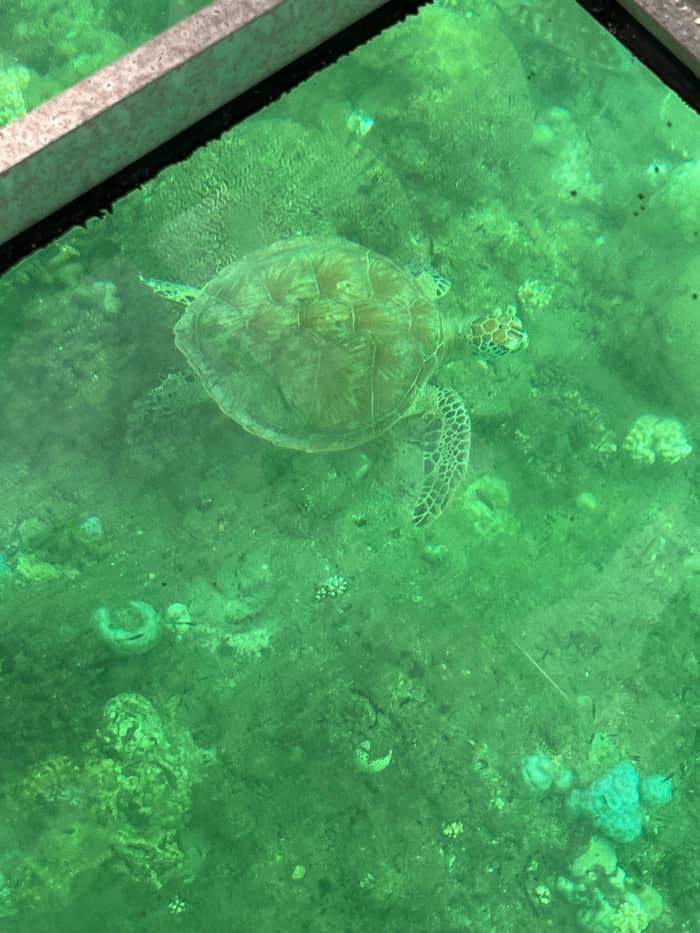
The animals most people hope for are the turtles. Calypso says giant green sea turtles are frequently sighted at Low Isles and reef sharks are quite common, while being honest that nothing can be guaranteed.27 Look also for giant clams: Tourism Port Douglas Daintree describes them as living around 100 years in the wild and sometimes weighing more than 200kg.28 The Reef Authority asks snorkelers to keep over a metre clear of giant clams, so admire the colored mantle from above.29
Small details make the swim easier. If you wear glasses, ask before you board: Sailaway keeps prescription snorkeling masks on its boats.24 Spit or defog the mask, push your hair out of the seal, and keep the snorkel on the side away from the guide's hand signals. Breathe slowly through the mouth and let the fins do the work with long, lazy kicks from the hip. When you want to stop, roll onto your back and float rather than standing up, because the bottom is reef, not a swimming pool floor.
Which swim suits you
Pick the wish nearest to yours; the trip beside it is the match.
If I am nervous and want to start from the sand
Wavedancer full day
All snorkeling starts from the island, with a safety officer on the beach.16,25
If I want the most time over the coral
Sailaway full day
The boat stays moored in the lagoon for 4.5 hours.
If We have half a day, no more
The half day sold here
It lasts 4 hours with a 30 minute crossing each way.
If Someone in my group will not swim
Any trip with a glass bottom boat
Non-swimmers can ride the glass bottom boat while others snorkel.
If I wear glasses
Sailaway
It carries prescription snorkeling masks.24
Pick your swim
Sold on this site
Short and early or late
Most guided
Beach-based snorkel
Longest in the water
Boat moored in the lagoon
You do not need to be a strong swimmer, but you do need to swim. Sailaway puts it plainly: some swimming ability is required, and guests who cannot swim are generally not allowed in the water to snorkel.3,31 It keeps swim vests for children and life jackets for adults, and the crew talks through your ability before you get in.4 Be honest at that moment. A crew who knows you are unsure will keep an eye on you and suggest the shallows first.
Quicksilver keeps a Snorkelling Safety Officer on the beach at all times.25 Buoyancy vests are suggested and are free to use.23 Its family notes add a sensible point for parents: young children and non-swimmers tend to lean on the adult beside them, so that adult should wear a flotation device too.34 A vest is not a sign of weakness out here; it lets you hang still over the coral instead of kicking to stay up.
If the water is not for you, the trip still works. The listing sold here asks for average fitness and mobility, since the day involves a beach walk, a swim and climbing in and out of the boat, and it adds a glass bottom boat ride to the swim. Tourism Port Douglas Daintree points those who dislike swimming to the glass bottom boat or a paddle board.35 Calypso says pregnant guests can travel to Low Isles, with free ginger tablets on board, and describes snorkeling as gentle exercise for those who feel up to it.36
A snorkel, start to finish
On the way out
Wavedancer runs a snorkeling demonstration during the crossing.12
At the island
Pull on a lycra suit against sun and stings.13
In the shallows
Start where you can stand; the depth runs from 0 to 5 metres.1
Over the reef
A marine guide leads the group around the lagoon.14
Back on the sand
Shade waits under trees and thatched umbrellas.15
Jellyfish are the reason everyone wears a suit here. Stingers never fully leave tropical Queensland water, the state government says, but November to May is the riskier stretch, and it suggests a full-body lycra suit.5,6 The Reef Authority makes the same point: a lycra or wet suit protects you from sunburn and from jellyfish stings.13 Tourism Australia adds that the stinger risk out on the reef is low, but still recommends suits.37
The operators supply them. Calypso includes all snorkel gear and lycra suits in its fare.21 Sailaway hands out lycra suits to everyone generally from November to May and offers wetsuits in the cooler months, usually June to October.38,39 Quicksilver says serious marine sting incidents in this area are extremely rare.40 Put the suit on before you reach the water's edge, pull the hood up if there is one, and keep it on while you wade.
The water is warm for most of the year. Quicksilver gives Tropical North Queensland water temperatures of 22 to 29 Celsius.20 Tourism Australia puts the sea off the Cairns northern beaches at 28.9 to 29.4 °C in summer and 23.8 to 24.5 °C in winter.19 Know the first aid, just in case: if someone is stung, call Triple Zero (000), ask for an ambulance and pour vinegar on the sting.41 Irukandji symptoms can take 20 to 40 minutes to appear, so mention any sting to the crew straight away.42
Video
Woombye Wildling on YouTube · Playback files load only once you tap play.
Each pool has an exquisitely beautiful population of tiny coral fish, which for their adequate description need the knowledge of an ichthyologist, the imagery of a poet and the brush of an artist
Low Isles lies within one of the marine park's Marine National Park Zones.43 That is the strictest everyday protection the park offers, and it shapes how you snorkel. You may not damage or take coral, including dead coral, or protected shells such as the giant clam without a permit.44 Leave every shell and piece of rubble where it lies; on a reef this small, a souvenir from every visitor would empty the beach.
The Reef Authority asks snorkelers not to lean on, hold or touch any part of the reef, and it notes that most damage comes from swimmers who lose control in the water, whether fighting a current, reaching for a closer look or framing a photo.45,46 Sailaway's own rule is short: walking directly on the reef is not permitted.32 Avoid kicking up sand and never feed the fish.47 If you need a rest, float, or head back to bare sand.
Turtles need room too. Swimming animals get right of way: no chasing, riding, grabbing or cutting across a turtle's path.33 Hands stay off the shell, and food stays on the boat.48 The best sightings come to swimmers who stay still near the seagrass and let the turtle decide how close to come. A camera held at arm's length gets a better picture than a chase, and the turtle keeps grazing.
Low Isles has a longer scientific record than almost any reef, and it helps to know it before you swim. A British and Australian team lived on the island in 1928 and 1929, and its leader, Maurice Yonge, wrote that every pool held fish that needed an ichthyologist, a poet and an artist to describe.49,50,26 Their work became the baseline later scientists measure against, which is why researchers keep coming back.
The comparison is not all good news. When Yonge returned in 1978 he found the reef surface he had known almost entirely dead, and he blamed sediment carried by the Daintree River after rainforest clearing.51 A 2018 survey for the Global Coral Reef Alliance found the shallow reef flat, once covered in hard corals, now dominated by soft corals and algae.52 Earlier work in the 1990s had measured phosphate and phytoplankton at four to five times their 1920s levels.53
That history explains what you see today. Expect soft corals, coral heads in patches, seagrass, fish and turtles rather than an unbroken garden of branching coral. It is a living, changing inshore reef, and snorkeling it with that in mind makes it more interesting, not less. If bright hard coral in clear blue water is your only goal, read our comparison of Low Isles and the outer reef before you book.
FAQ
Quicksilver gives that range and notes the corals sit close to the island, so you are never far above the reef.1
Calypso says green turtles are frequently sighted here but that no marine life can be guaranteed.27
Tourism Australia gives that window for the best underwater visibility from Port Douglas.7
Sources
Continue reading
Choosing a Low Isles boat? Ask a real person here.